Body Type Calculator

Creator
Reviewer

This body type calculator covers both common meanings of "body type." The Body Shape tab classifies your silhouette, hourglass, pear-leaning triangle, rectangle and more, from your bust, waist, high hip and hip measurements, and shows your waist-to-hip ratio alongside it. The Frame Size tab estimates your skeletal frame, small, medium or large, from your height and wrist circumference. Pick a tab, enter your numbers in metric or imperial units, and the result updates as you type.
If you have been asking what is my body shape before a shopping trip, the Body Shape tab gives a repeatable answer from your own measurements instead of a guess. Unlike a body type quiz, it works from your actual numbers, and as a female body shape calculator it follows a classification built from research on women's bodies; the Frame Size tab has separate bands for men and women. Both tools are informational, used for clothing fit and general screening context respectively, not a medical or aesthetic verdict on your body. Nothing is uploaded anywhere: every number stays in your browser, and the formula used is shown next to the result rather than hidden behind the calculator.
How to determine your body type: what the four measurements mean
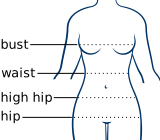
Body Shape sorts a silhouette into one of seven categories using four circumference measurements: bust, waist, high hip and hip. Together they work like a compact body measurement chart, and figures such as 36-27-38 are often called a BWH measurement. The table below covers how to measure bust, waist, hips and the high hip: use a soft tape, keep it level and snug, and measure the same way each time.
Body type measurements: where the tape goes
| Measurement | Where the tape goes | Tip |
|---|---|---|
| Bust | Around the fullest part of the chest, level across the back | Wear a fitted, non-padded bra and breathe out normally |
| Waist | Around the narrowest part of the torso, usually just above the belly button | Snug, not tight, and do not pull your stomach in |
| High hip | About 7 inches (18 cm) below the natural waist, over the upper swell of the hip | This is the band many trousers and skirts sit on |
| Hip | Around the fullest part of the hips and buttocks | Feet together, tape parallel to the floor |
From those four numbers, the calculator compares the differences between bust and hip, bust and waist, hip and waist, and the ratio of high hip to waist, against published numeric bands for each shape. Hourglass shapes have a bust and hip close in size with a notably smaller waist between them, the silhouette most people picture first as an hourglass body. Triangle and inverted triangle shapes have one of bust or hip clearly larger than the other with less waist definition. Spoon and bottom hourglass shapes both have fuller hips than bust, split from each other by how the high hip measurement compares to the waist. A rectangle body shape, what this classification calls Rectangle, has bust, waist and hip measurements that stay fairly close together, without a sharply defined waist. The classification algorithm is published in Lee, Istook, Nam & Park, "Comparison of body shape between USA and Korean women," International Journal of Clothing Science and Technology, Vol.19, No.5, 2007.
A few of these seven names have a more familiar everyday counterpart. What this classification calls "Triangle" is what most people mean by a pear shape, fuller hips than bust or shoulders. The difference between a pear shape and an hourglass comes down to exactly that waist definition: a pear shape carries the width in the hips with a less dramatic waist, while an hourglass carries width in both bust and hips with a sharply smaller waist between them.
Because the published bands are numeric thresholds rather than a single sliding scale, a small number of measurement combinations do not clearly fall into any of the seven categories, and a small number of others sit close enough to two bands that this calculator has to pick the one the source lists first. Either way, this is expected behaviour built into the original research, not a bug in this tool, and the result says so plainly rather than guessing.
The seven shapes and their exact rules
Here is how to tell what body type you are from four measurements: the calculator checks the seven shapes in the order below and reports the first rule that fits. All differences are in inches; a centimetre entry is converted first. The wording of the rules is the published classification, not a judgement about any shape.
| Shape | Rule |
|---|---|
| Hourglass | Bust − hips ≤ 1, hips − bust < 3.6 and bust − waist ≥ 9; or hips − waist ≥ 10 |
| Bottom hourglass | Hips − bust from 3.6 up to 10, hips − waist ≥ 9 and high hip ÷ waist < 1.193 |
| Top hourglass | Bust − hips above 1 and below 10, and bust − waist ≥ 9 |
| Spoon | Hips − bust > 2, hips − waist ≥ 7 and high hip ÷ waist ≥ 1.193 |
| Triangle (pear) | Hips − bust ≥ 3.6 and hips − waist < 9 |
| Inverted triangle | Bust − hips ≥ 3.6 and bust − waist < 9 |
| Rectangle | Hips − bust < 3.6, bust − hips < 3.6, hips − waist < 9 and bust − waist < 10 |
Source: Lee, Istook, Nam & Park (2007), as implemented in this calculator.
Worked example. A bust waist hip size of 36-27-38 inches, with a high hip of 35, gives bust − hips = −2, hips − bust = 2 and bust − waist = 9. Hourglass body measurements are the most strictly defined of the seven, with two separate rules. Here all three parts of the first rule hold, so the result is Hourglass, and hips − waist = 11 meets the second rule as well. The waist-to-hip ratio is 27 ÷ 38 = 0.71.
Body shapes in fashion, and what this body type calculator adds
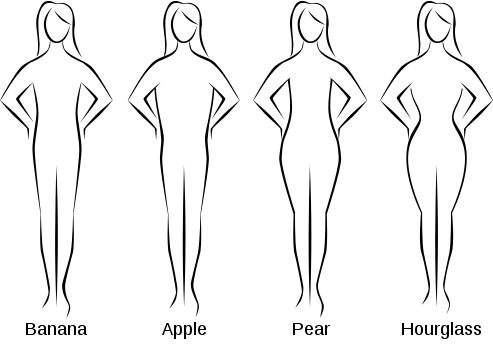
Clothing and styling guides usually work from a simpler, four-shape version of the same idea: Banana (also called straight or rectangle), Apple (also called inverted triangle), Pear (also called spoon or triangle), and Hourglass. A 2005 study of more than 6,000 women at North Carolina State University found roughly 46% were banana-shaped, about 20% pear-shaped, just under 14% apple-shaped, and 8% hourglass-shaped, with the remainder not clearly matching any single category.
Advice on how to dress for body type usually starts from those four names. Clothing is cut on averages, though, and differences between brands matter more than the shape name. This tool describes proportions only: it is not a dress size calculator or a clothing size calculator, and no measurement here predicts a size in any brand.
The waist-to-hip ratio (WHR), in context
Alongside the shape result, the calculator shows your waist-to-hip ratio: your waist measurement divided by your hip measurement. A lower WHR means a proportionally smaller waist relative to the hips, and a higher WHR means the two measurements are closer together.
WHR also appears in public health research as a general population-level reference point, not a personal diagnosis. The National Institute of Diabetes and Digestive and Kidney Diseases (NIDDK) associates a WHR above 0.8 in women and above 1.0 in men with higher health risk linked to where body fat is carried, and the World Health Organization defines central obesity by this measure as a WHR above 0.90 for men or above 0.85 for women. A frequently cited supporting study is Yusuf S, et al., "Obesity and the risk of myocardial infarction in 27,000 participants from 52 countries: a case-control study," Lancet, 2005;366(9497):1640-9. These figures are presented here as background information, in the same neutral way this page presents everything else, not as a verdict on any one person’s result.
What skeletal frame size means, and why it is measured with a wrist-to-height ratio
Skeletal frame size describes how broad or narrow your bone structure is relative to your height. It is not about muscle or fat at all, it is about the underlying skeleton those tissues sit on. Two people can be the exact same height and weight yet have noticeably different bone structures, which is part of why weight charts built only from height and weight can feel like they do not quite fit everyone.
The standard, widely used method for estimating frame size from home is the wrist-to-height ratio:
The wrist is a convenient, easy-to-measure proxy for overall bone thickness, so a relatively thick wrist for a given height signals a broader frame, and a relatively thin wrist signals a narrower one. The bands that translate this ratio into "Small", "Medium" or "Large" differ for men and women, because average bone proportions differ between the two groups.
Worked example. A man who is 180 cm tall measures his wrist at 17 cm. Dividing height by wrist gives 180 ÷ 17 = 10.588, which rounds to a ratio of 10.6. Checked against the male bands, a ratio above 10.4 falls into "Small", so this ratio is classified as a small frame. The same formula applies for an imperial entry: the calculator first converts feet, inches and wrist inches to centimetres, then runs the identical division, so both unit tabs always agree.
"Body type" also means somatotyping, and neither tab computes that
In everyday fitness language, "body type" is also used for a third idea: somatotyping, which sorts people into ectomorph (naturally lean, narrow build), mesomorph (naturally muscular, athletic build) and endomorph (naturally higher body fat, rounder build). These categories are popular in gyms and fitness content because they offer a quick, intuitive way to talk about build.
The honest limitation is that, unlike Body Shape or Frame Size above, there is no single agreed numeric formula that measures a somatotype from measurements you can take with a tape measure at home. Somatotyping in its original academic form involves detailed anthropometric photography and rating scales, and the simplified versions common online are informal approximations that differ from one source to the next. Rather than presenting one of those informal, inconsistent formulas as if it were a precise calculation, this calculator sticks to two objective, repeatable, published methods instead.
Frequently asked questions
What is the difference between "Body Shape" and "Frame Size" on this page?
How do I measure my bust, waist, high hip and hip correctly?
Why did my measurements not clearly match one of the seven shape categories?
What does my waist-to-hip ratio (WHR) mean?
How do I measure my wrist circumference correctly for the Frame Size tab?
What do ectomorph, mesomorph and endomorph mean, and why is Frame Size not based on them?
Are the Body Shape and Frame Size results exact, like a medical measurement?
Where do I measure my waist?
How do you measure hips?
What's my body type if I measure between two shapes?
Related tools: BMI Calculator, Body Fat Calculator and Calorie Calculator. More are grouped under Fitness & Health Calculators, and every tool on the site is listed at all calculators.